

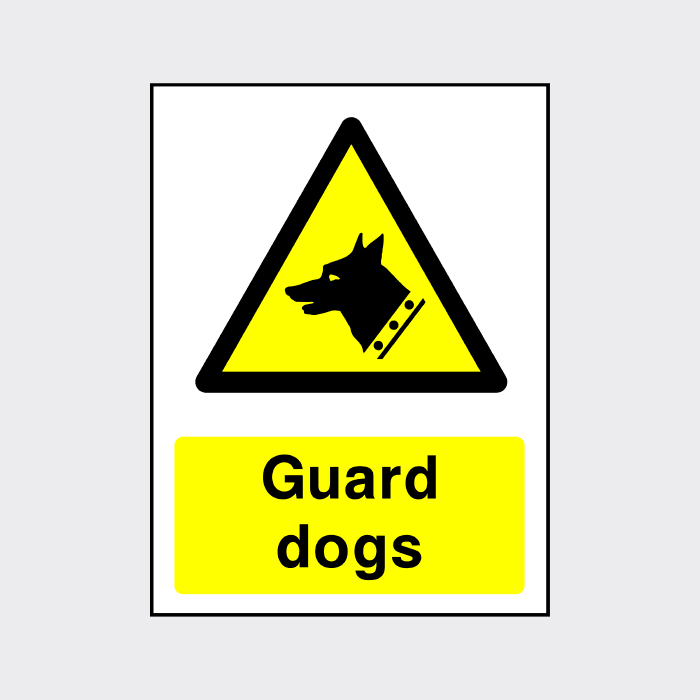
What this sign is for
If you use a guard dog at commercial premises in England, Wales or Scotland, section 1(3) of the Guard Dogs Act 1975 requires a notice warning that a guard dog is present to be clearly exhibited at each entrance to those premises. Not the main gate. Every entrance. This is that notice.
Available in three sizes and six materials, dispatched in two working days from our Burnley print works, with free delivery on orders over £25.
The legal position
What the Act actually requires
Section 1(3) of the Guard Dogs Act 1975 states that a person must not use, or permit the use of, a guard dog at any premises unless a notice containing a warning that a guard dog is present is clearly exhibited at each entrance to the premises.
Displaying the notice is only half of it. Section 1(1) separately requires a handler capable of controlling the dog to be present on the premises, with the dog under that handler's control at all times unless it is secured so it cannot go freely about the premises. A sign does not make an unattended guard dog lawful.
Where the duty applies — and where it doesn't
Section 7 defines "premises" as land other than agricultural land and land within the curtilage of a dwelling-house, and buildings other than dwelling-houses. In practice:
- The duty applies to yards, depots, warehouses, industrial units, builders' merchants, storage compounds, car and plant dealerships, scrapyards and commercial premises generally.
- The duty does not apply to agricultural land, or to land within the curtilage of a dwelling-house — so a farm field or a domestic garden falls outside section 1. A farmyard containing commercial buildings may well fall inside it; the boundary is a question of fact about the land in question.
The Act extends to England, Wales and Scotland. It does not extend to Northern Ireland.
Penalty for not displaying a notice
Section 5(1) makes contravention of section 1 a summary offence carrying a fine not exceeding level 5 on the standard scale. Since 12 March 2015, level 5 fines in England and Wales have been unlimited. In Scotland, level 5 remains capped at £5,000. Pages quoting a flat £5,000 figure for England and Wales are working from the pre-2015 position.
What the Act does not specify
The Act sets no minimum size, no mounting height, no colour scheme and no prescribed form of words. The whole statutory test is that the notice is "clearly exhibited". A sign legible to someone approaching the entrance meets that test; one hidden behind foliage or fixed at ankle height does not, whatever its size.
A caution for domestic buyers
Section 1 does not apply within the curtilage of a dwelling-house, so there is no statutory duty to display this sign at a home. There is also a reason to think twice. Under section 2(2) of the Animals Act 1971, a keeper can be strictly liable for damage caused by an animal where they knew of characteristics making it likely to cause severe damage. A guard dog notice at a private house can be produced as evidence that the keeper knew the dog posed a risk. If you keep a pet rather than a working guard dog, a "Please keep gate closed — dog in garden" notice does the practical job without the same evidential problem.
Where to fix it
Take "each entrance" literally. Courts have never had to define the word in this context, and the sensible reading is any point at which a person can enter, not just the ones you intend them to use:
- Every vehicle gate, including delivery and contractor gates kept locked most of the time
- Every pedestrian gate and personnel door in a perimeter fence
- Any gap, breach or unsecured section of boundary that a person could walk through
Mount at approximately eye level — 1.5 to 1.8m to the centre of the sign — on the approach side, so it is read before the entrance is crossed rather than after. A gate that opens inwards will swing the sign out of view; on those, fix to the adjacent post or fence panel instead of the gate leaf.
The 150 x 200mm size suits a pedestrian gate or door read from one to two metres away. The 300 x 400mm size is the usual choice for a vehicle gate read from a stopped car. The 450 x 600mm size is for long approaches, perimeter fencing set back from the road, and sites where the sign must register from a moving vehicle.
Choosing the material
Standard Vinyl Sticker
A self-adhesive sticker for smooth, clean, non-porous surfaces: a painted steel gate, a glazed door, a powder-coated fence panel, a plastic-clad wall. It becomes part of the surface, so there is nothing to unscrew and nothing to work loose. It is not a good choice for anything textured, dusty or flaking.
High Tack Vinyl Sticker
The same format with a more aggressive adhesive, for surfaces that defeat standard vinyl: textured render, brick, breeze block, weathered timber, galvanised steel and powder-coated finishes that resist adhesion. If you have tried a sticker on a wall before and found it curling at the corners within a season, this is the version to order.
Fluted Correx Board
A fluted polypropylene board — light, cheap, and the standard choice for cable-tying to a mesh or palisade fence. It is the right material for a compound that will be gone in six months, a site perimeter that changes as work progresses, or anywhere you need twenty notices up quickly across a long boundary. Its flutes run in one direction, which makes it flexible across the flutes and stiffer along them.
5mm Foam Board
A lightweight rigid board best suited to interior use — a reception wall, a corridor, a staff entrance inside a building. It takes a clean flush fixing without needing a frame. Foam board is not the choice for an exposed external gate.
Rigid Plastic
The everyday external sign material. Rigid, flat, unaffected by rain, and stiff enough to hold its shape screwed to a post or bolted to a gate. For most commercial buyers putting a permanent notice on a permanent entrance, this is the sensible default.
ACM Board
Aluminium composite — two thin aluminium skins bonded to a polymer core. It is the most rigid and most impact-resistant option here, and the one that stays flat on a large sign in wind where a thinner material would flex and drum. Choose it for the 450 x 600mm size on an exposed perimeter, for coastal and high-wind sites, and for entrances where a sign will be knocked by vehicles or equipment.
Fixing guidance by material
Signs are supplied without fixing holes. The vinyl options need no drilling at all. The four board materials can be fixed with tape or ties, or drilled on site to suit your own fixings — guidance for each is below.
Vinyl (Standard and High Tack)
Clean the surface with isopropyl alcohol or a degreaser and let it dry fully. Do not apply below 10°C — the adhesive will not key and the edges will lift. Apply from one edge with steady pressure rather than laying the whole sheet down at once, and work outwards to push air ahead of you. Adhesive reaches full bond strength over 24 to 48 hours; don't pressure-wash the area during that period.
Fluted Correx Board
Cable ties into mesh or palisade fencing is the fastest method and needs no drill — a bradawl or a screwdriver tip will pierce the board cleanly. Make four holes, one near each corner, roughly 20 to 25mm in from the edges, and pass the ties through the flutes rather than across them. Don't overtighten; the flutes crush and the board puckers. For a solid surface, exterior-grade double-sided tape avoids piercing the board at all.
5mm Foam Board
Interior mounting tape or hook-and-loop pads on a clean wall, which is the cleanest result and needs no holes. If you do screw it, drill first rather than driving straight through, and use penny washers — a screw head alone will pull through the foam core.
Rigid Plastic
Mark and drill four holes with a sharp HSS bit, backing the sign with a scrap of timber so the underside doesn't tear out. Drill each hole 1 to 2mm larger than the screw shank and keep fixings 20mm or more from the edge, so the plastic can expand and contract with temperature without cracking around the fixing. Use penny washers, and leave the screws slightly proud rather than winding them down hard. On metal gates, self-tapping screws or nuts and bolts through the gate frame.
ACM Board
Drill with a sharp HSS bit at moderate speed; the aluminium skin cuts cleanly and the composite will not tear like a single-skin board. Fix with screws or bolts and washers. ACM takes a fixing closer to the edge than the other boards without deforming, which is why it suits bolting tight to a gate frame. On a flat, clean, solid surface, exterior-grade heavy-duty tape avoids drilling altogether.
Frequently asked questions
Is a guard dog sign a legal requirement in the UK?
Yes, at commercial premises. Section 1(3) of the Guard Dogs Act 1975 makes it an offence to use or permit the use of a guard dog at any premises unless a notice warning that a guard dog is present is clearly exhibited at each entrance to those premises. The Act extends to England, Wales and Scotland, but not to Northern Ireland.
How many guard dog signs do I need?
One at every entrance. The Act says "each entrance to the premises" and does not define "entrance", so the safe reading is every point a person could enter — vehicle gates, pedestrian gates, personnel doors, and any gap or breach in a boundary fence. A site with a main gate, a delivery gate and a side pedestrian gate needs three signs, not one.
What size does a guard dog sign have to be?
The Guard Dogs Act 1975 specifies no minimum size, height, colour or wording. The requirement is that the notice is "clearly exhibited". In practice, 150 x 200mm suits a pedestrian gate read from one to two metres, 300 x 400mm suits a vehicle gate read from a stopped car, and 450 x 600mm suits long approaches and perimeter fencing.
What is the penalty for not displaying a guard dog sign?
Under section 5(1) of the Guard Dogs Act 1975, contravening section 1 is a summary offence carrying a fine not exceeding level 5 on the standard scale. Since 12 March 2015 level 5 fines have been unlimited in England and Wales. In Scotland the level 5 maximum remains £5,000.
Does putting up a sign mean I can leave a guard dog unattended?
No. Section 1(1) of the Guard Dogs Act 1975 requires a handler capable of controlling the dog to be present on the premises, and the dog to be under that handler's control at all times, unless the dog is secured so that it cannot go freely about the premises. Displaying the notice satisfies section 1(3) only; it does not affect the handler requirement.
Do the signs come with fixing holes?
No. All sizes and materials are supplied without pre-drilled holes, so you can position fixings to suit your gate, post or wall rather than working around holes that don't line up. The vinyl options are self-adhesive and need no drilling. Correx can be pierced with a bradawl for cable ties. Rigid Plastic and ACM can be drilled on site with a standard HSS bit.
Do I need a guard dog sign on a farm?
Section 7 of the Act excludes agricultural land from the definition of "premises", so the section 1 duty does not apply to agricultural land itself. It can still apply to commercial buildings and yards on a farm holding — a machinery store, a workshop, a haulage or contracting yard. Where a dog is guarding buildings and plant rather than land, treat the duty as applying.
Do I need one at my house?
No. Section 7 excludes land within the curtilage of a dwelling-house from the definition of "premises", so there is no statutory duty at a private home. Be aware that a guard dog notice at a domestic property can be cited as evidence of knowledge of a dog's characteristics in a claim under section 2(2) of the Animals Act 1971.
Which material should I order for a metal gate?
For a smooth painted or powder-coated gate, Standard Vinyl Sticker if the finish is clean and smooth, High Tack Vinyl Sticker if it is galvanised, weathered or textured. For a mechanical fixing, Rigid Plastic bolted through the gate frame, or ACM Board at 450 x 600mm where wind loading would flex a thinner board.
Which material should I use on a mesh or palisade fence?
Fluted Correx Board, cable-tied through the flutes with four ties set roughly 20 to 25mm in from each corner. It is the cheapest way to cover a long perimeter with multiple entrances, and no drill is needed — a bradawl will pierce the board.
How quickly will it arrive?
Signs are printed and dispatched within two working days. Delivery is free on orders over £25.